
 BY SM Haider Al
We live in a digital age, where rapid technological change is the key to your success, and it's easy to learn How to get your blog noticed by google in 2022. MethodS of Getting Traffic to Your Blog: Proven Methods (2022)
If you ask a marketer or business owner what they’d like most in the world, and they’ll probably tell you “more customers.” What often comes after customers on a business wish list? More traffic to their site.
There are many ways you can increase traffic on your website, and in today’s post, we’re going to look at 52 of them, including several ways to boost site traffic for FREE.
Starting your blog or website to make money online and pursue your passion has become easy.But with so much noise in the internet world, driving traffic to your posts and articles can be challenging.
But no worries, in this article,I’ve got you covered on how to get traffic to your blog with proven methods.You’ll explore and learn several methods to increase blog traffic In this article.
All these ways are free as long as you don’t outsource services for following them.These methods and strategies will help you to reach 250K Visits per month and the number will be increasing every single month.
2. Get Social
It’s not enough to produce great content and hope that people find it – you have to be proactive. One of the best ways to increase traffic to your website is to use social media channels to promote your content.
Twitter is ideal for short, snappy (and tempting) links, whereas Google+ promotion can help your site show up in personalized search results and seems especially effective in B2B niches.
If you’re a B2C product company, you might find great traction with image-heavy social sites like Pinterest and Instagram. Here's more advice on making the most of social media marketing.
3. How to Get Traffic to Your Blog for Free
Once you set up your blog, it’s time to increase blog traffic for free. After getting a substantial boost in traffic, you can use paid methods to increase your blog’s traffic as well.
There is no magic formula for content marketing success, despite what some would have you believe. For this reason, vary the length and format of your content to make it as appealing as possible to different kinds of readers.
Intersperse shorter, news-based blog posts with long-form content as well as video, info graphics and data-driven pieces for maximum impact.
4. Create & Understand Your Users’ Persona
Whenever I start my blogs, I always create and then understand the personas of my potential readers.
It’s important to understand your blog’s users to create a strategy to fulfill their needs. Only then can you bring in traffic.

While it sounds daunting to create your users’ persona, it isn’t. All you need is to answer the following questions:
Who is your target audience?
What’s the target age group?
What are the problems of your audience?
How will your potential users find a solution, and where?
How much do they already know about a particular topic or problem?
The more questions you’ll answer, the better understanding you’ll develop. After that, use the information to help your blog’s users solve a problem.
5. Start Grabbing Email Subscribers

Build a stronger connection with your audience
Building your Email list is important for almost any business model that you have. These are the people that really enjoy your content.
They like to hear from you on a regular basis.They are the people that will potentially become your customers.
For those of you that think that people don’t open their email anymore, Some website got up to 40,000 visitors per month just from email like 40+ Sty
It can be frustrating, some emails end up in spam, some people never open your email, but a lot of them still do.
The people that do are your most loyal fans.
When people come to your website, you really need to try to get them to return.
Oftentimes, people end up on your website, check it out, might like it, but leave and may never come back, You only get a very small window of opportunity to capture their email address.
Make it easy for people to opt in to something on your site.
THE ADVANTAGES OF BUILDING AN EMAIL LIST:
Unless they unsubscribe you have the permission to email the people on the list.
If you do this in a positive, constructive and engaging way, always giving opt out options, email is one of the best ways to stay in contact with your readers and potential customers.

THE DISADVANTAGES OF AN EMAIL LIST:
Not all of your emails will be delivered to all of the people on the list. You have to always remind people to whitelist your email address, to move emails that and might end up in spam or in the promotions folder to the inbox so that your emails actually arrive at the right place.
When your email list grows your expenses with your email service provider will increase. If you’re using your list effectively though, you should easy make a good return on your investment.
If you’re new to blogging, you are likely to spend your time only driving new users to your website.
And that is a big mistake! Why? Because 70% of your users leaving your blog will never return. Then why bother getting the traffic in the first place?
My recommendation is to build your email list even if your blog is new. Once you start collecting your users’ email addresses, start sending emails to bring traffic to your blog.
6. Make Use of Editorial Calendar
After doing the keyword research, you must have tons of post ideas to share on your blog.
But honestly, it can be overwhelming to deal with a large list of keywords. Organizing makes things easy and practical.

So, create an editorial calendar to keep track of all the posts. This way, you’ll stick with your content plan and thrive in the long-run. Otherwise,
most people quit after writing two to three blog posts only. The choice is yours!Content marketing is a very time-consuming task but it’s also highly effective when done right.
In order to generate better results from your content marketing, try to plan your editorial calendar in advance, particularly by focusing on your marketing objectives.
This will not only improve your productivity and save you time, but it can even improve your ROI as you’re focused solely
on content that gets results and optimizing your strategy as you go along to keep improve your strategy and ROI.

5 Steps To Build A Powerful Editorial Calendar For Your Business
Be consistent but don’t be too hard on yourself. Start with a post each week and rock!
Tip: you can use Notion to organize not only your Blog, but Your Life too!
7. Relish The Power of Push Notification

Whenever you visit a website, you usually view a push notification asking you to get notified of new content.
It’s a wonderful way to generate traffic to your blog seamlessly. I like it because I can engage with my visitors after they’ve left my blog.
Bonus: You can use many tools and WordPress plugins to send push
notifications even if you aren’t techy.
8. Create Useful Content Using Images, Charts, Videos, & More

Create a valuable piece of content for your blog’s users, the most important way to increase blog traffic.
And it’s my favorite! Write on the topics your users cannot resist reading it.

Create as many pillar articles and blog posts as possible.
Add images, charts, videos, info graphics, tables, and every other thing which adds value to your users.

Go in-depth about the subject you’re writing about. Prove your authority in your niche, and you will bring in a lot of traffic to your blog.

Bonus: Create how-to guides, comparison tables,
listicles, tutorials, and so on.
💡Tip: One of my favorite tools that I use almost every day to create graphics, posts, banners, and design everything is Canva. And what's nice is that you can use it Totally for free!
9. Make Your Content Extremely Understandable for Your Readers
Search engines love long pieces of content. But your blog’s users may or may not love them.
Make your blog posts and articles extremely readable for your users.Most of the time, they don’t read but understand your content. Your readers don’t want to get impressed by your top-notch vocabulary.
They want a solution to their problem. All you need is to help them understand the subject so that their life gets easier than before. That’s just it!
1. Use simple words, write short sentences and paragraphs.
2. Use headings, sub
headings, bullets, and numbering. 3. Improve the typography of
your blog or website.Improve the typography of your
blog or website.
10. Write Attractive Headlines to Drive Traffic to Your Blog
Headlines are one of the most important parts of your content. Without a compelling headline, even the most comprehensive blog post will go unread.
Master the art of headline writing. For example, the writers at BuzzFeed and Upworthy often write upward of twenty different headlines before finally settling on the one that will drive the
most traffic, so think carefully about your headline before you hit “publish.”When users of a search engine find your blog post in search results, they will see its headline.
They’ll click on your post only if the headline is attractive. Your titles should not be click bait but click-worthy. Period. A killer headline causes some emotional response and offers reward or value.
You should be creative enough to encourage a click to your article or post and still add your target keywords.
Bonus: Use call-to-action along with power words associated with human emotions.
💡 Tip: you can use MonsterInsights. A free WordPress Plugin that will help you write better headlines with the Free Headline analyzer that is built in with this Plugin.
11. Target Long-Tail Keywords
Got your high-intent keyword and popular keyword bases covered? Then it’s time to target long-tail keywords, too.
Long-tail keywords account for a majority of web searches, meaning that if you’re not targeting them as part of your paid search or SEO efforts, you’re missing out.

12. Start Guest Blogging
Before you say it – no, true guest blogging isn’t dead, despite what you may have heard. Securing a guest post on a reputable site can increase blog traffic to your website and help build your brand into the bargain.
Be warned, though – standards for guest blogging have changed radically during the past eighteen months, and spammy tactics could result in stiff penalties. Proceed with caution.
13. Invite Others to Guest Blog on Your Site
Guest blogging is a two-way street. In addition to posting content to other blogs, invite people in your niche to blog on your own site.
They’re likely to share and link to their guest article, which could bring new readers to your site.
Just be sure that you only post high-quality, original content without spammy links, because Google is cracking way down on low-quality guest blogging.
14. Go After Referral Traffic
Rather than trying to persuade other sites to link back to you (a tedious and time-intensive process), create content that just begs to be linked to.
When Larry wrote about the kick in the proverbial teeth that eBay took from Google’s Panda update, we managed to secure a link from Ars Technica in the Editor’s Pick section alongside links to The New York Times and National Geographic.
Not too shabby – and neither was the resulting spike in referral traffic. Learn what types of links send lots of referral traffic, and how to get them, in this post.

15. Automate Sharing Your Blog Posts
Social sharing can be a powerful way to drive traffic to your blog and website. But you need to share posts to attract social media users regularly.
There are tons of tools you can use to automate sharing your blog posts on social media.
I use Content Studio, which helped me automate almost every single post on my social profile. you can give it a try if you want!

16. How to Get Traffic to Your Blog Using Q&A Sites Like Quora.com
Question and answer sites like Quora.com help bring in a lot of traffic to your website or blog.
Let me give you a few reasons to participate in Q&A sites. Firstly, these websites have impressive domain authority.
Secondly, there’s a large audience for you to target. Keep adding value with your answers, and people will get back to your blog.
I don’t recommend going to these sites and spamming links to your blog.
Bonus: Add value to users of Q&A sites and then
add links that might add more value.
17. Repurpose Your Content
Repurposing content refers to changing the existing content for other platforms and formats.
For example, if you have a blog post, turn it into an infographic. Repurpose an article to a social media post.
Benefit? You don’t need to spend a lot of time and bucks to create content from scratch.
Use the existing content as a framework for a new piece of content. This way, you also share your content with a completely new audience.
Bonus: Split a long blog post into small pieces and
think about what you can do with them! example? Quora Space
18. Increase Blog Traffic With Social Media
Remember when I told you to bring your visitors to your email list to get them back to your blog? Create your social media profiles.
Add link back to your blog. Post regularly. And share valuable content. People will visit your blog more often. Again, you can automate all this with Social Media automation tools like Content Studio, Hootsuite, Buffer…
19. Post Content to LinkedIn
LinkedIn has become much more than a means of finding another job. The world’s largest professional social network is now a valuable publishing platform in its own right,
which means you should be posting content to LinkedIn on a regular basis.Doing so can boost traffic to your site, as well as increase your profile within your industry – especially if you have a moderate to large following.

20. How to Use Pinterest to Drive Traffic to Your Blog

Pinterest is a powerful search engine for visual content. It has over 459 million monthly active users in the world.
Its Pins rank high for several keywords in search engine result pages (SERPs). Create Pins and link them to your blog posts.
Pinterest images can last a long time. It’s not like Facebook. When you share an imagethere, you get a little boost of traffic that disappears almost instantly.
With Pinterest yourpin can last for months or even years.Pins get shared all the time from person to person.
Whenever someone shares an image of mine, and clicks on it, I get a new visitor to my website.
Every month, many people can discover your site and programs, through Pinterest.
To take full advantage of this strategy, you can create a special image for Pinterest with each article.
you make sure that image has a nice big title on it so that it’s clearly visible from the image what the article is all about.
You want to pique people’s interest on Pinterest so that they click on your article and go to your website.
The disadvantage is that you do have to create that extra image for your website which will take a bit of extra time. It is not that difficult to do.
It can often be just a slight variation on your article’s main feature image. Don’t wait for other people to submit your article to Pinterest, submit it yourself.
Especially when you are building a following, the image can spread very quickly.You must also remember to pin some images that aren’t from your own site as well.
Once you start pinning every day, your own pins and other people’s, you’ll start to see a huge increase in the number of visitors that you get to your website.
Grow your followers on Pinterest to increase traffic substantially in the long-run. Don’t ignore SEO here.
Always use relevant keywords in your Pins & Boards. Join other group boards to expose your content to more people.
Bonus: Use ‘Guided Search’ in Pinterest to extract keywords for your niche.
21. Using Facebook to Increase Blog Traffic

Facebook is still a major player even though it’s not as important as Pinterest for my site.
THERE ARE TWO MAIN WAYS TO ENGAGE AND BUILD AN AUDIENCE ON FACEBOOK.
The first is using a Facebook page. Share every post you write as well as sharing other posts that are relevant to your business and your subject.
This will keep your Facebook page active and give you some traffic to your website.
The second is a Facebook group.
Starting a group can give you the potential for a lot more traffic to your website.
In the beginning of a new group, you need to nurture it. You may also often need prompts for people to share within the group.
Over time, as the group grows and the community becomes engaged, members will start their own posts and prompts will no longer be required.
You do need some bandwidth for this option because of the time involved at the start of the group.
If people enjoy the group, they will invite their friends to join and the group will grow organically and often quickly.
You may have a private Facebook group for 40+ Style with more than 7000 active members.
When You have a new article, a promotion, or something to share You can do it in the group and it’s guaranteed to generate traffic to the website.
It’s a great way to build community around a brand while supporting your business, building traffic and engage your audience.
ADVANTAGES OF USING FACEBOOK AND FACEBOOK GROUPS
- Free opportunity to grow faster.
- Get a lot of engagement fast
- Make it easy for friends to refer them to your page or group
DISADVANTAGES OF USING FACEBOOK
It can be quite time consuming, especially in the beginning of a new group.
Facebook, of course, is very good at distracting you. You don’t want to spend a lot of your time on Facebook, you want to spend more time creating your programs and your own content.
You don’t have full control over the content and group. If Facebook changes their policies or stops showing your posts to people, there’s nothing you can do about it.
With 2.9billion users, Facebook is the largest social media platform in the world. With that said, you can use it to drive traffic to your blog.
Create a Facebook Business Page for your blog and share images with catchy captions.And Don't Forget to make use of Facebook Messenger.
Bonus: Ask questions, reply to comments, share a quote
from your post, and don’t use Facebook links.
22. How to Use Instagram to Drive Traffic to Your Blog
Using Instagram to drive traffic is a challenge because the platform doesn’t allow links in the posts. But with a few tactics, you can generate traffic to your blog from Instagram.
Add a link to your blog in your bio. Use a call to action. Include your blog in videos. and if you have 10K Followers or more, you can Start Attaching Links to your stories! believe it's a great source of traffic!
Bonus: Try Instagram ads if you want to spend a few bucks. And
leverage the power of influencers on the platform.
23. Explore Other Social Media Networks
I’m not telling you to be everywhere. But explore every social media network to know which one is right for your blog.
For example, if your blog is about entrepreneurship, you may want to engage with LinkedIn users.
For a fashion website, Instagram or Pinterest would be perfect.
24. Get Your Blog Noticed by Google
Getting your blog noticed by Google is important to bring in organic traffic:
Google Search Console is a free service offered by Google that helps you monitor, maintain, and troubleshoot your site's presence in Google Search results.
You don't have to sign up for Search Console to be included in Google Search results, but Search Console helps you understand and improve how Google sees your site.
Let’s see what you can do to improve your rankings on the search giant.
25. How to Get Traffic to Your Blog Using SEO
SEO stands for search engine optimization. You optimize your blog according to the search engine, so it ranks it well.
Use the best SEO practices to boost your blog traffic. Sprinkle keywords across your content naturally, add images, and do strong interlinking.
Think SEO is dead? Think again. Optimizing your content for search engines is still a valuable and worthwhile practice. Are you making the most of image alt text?
Are you creating internal links to new content? What about meta descriptions? Optimizing for on-page SEO doesn’t have to take ages, and it could help boost your organic traffic.

Keywords are words and phrases people use to find a piece of information. Choosing the right keywords is important because only then can you target your users.
These keywords have clear search intent and substantial volume opportunities. The keywords for your blog should sync with your blog’s mission.
There are various ways to do this:
a survey,
Google searches,
using Google autocomplete
or a keyword search.
While I won’t go into details on keyword research here, there is a good tool for keyword searches I like to use called KWFinder.
If you use this tool, the website will give you some hints around how best to use it.
Once you have a list of keywords you can start writing articles including them and the subjects and phrases you researched.
INITIALLY YOU WILL WANT TO FOCUS ON ONE KEY PHRASE PER ARTICLE
You might have a key phrase that’s really important that you really want to rank for.If that’s the case, your main article might be ‘How to wear jewelry’.
Then your supporting articles could be about what jewelry to wear with a red skirt, or what jewelry to wear to a wedding.
Those other articles could still be ranked for those longer key phrases but your main article on ‘How to wear jewelry’ might be ranked as well.
If you start linking all these jewelry articles back to your main article, you build a little web of links inside your own site that will help your SEO.
SOMETHING THAT WILL ALSO REALLY HELP YOUR SEO / VISIBILITY IN GOOGLE IS TO HAVE OTHER SITES LINK TO YOU.
One way is to leave comments on other websites. A more impactful link back to you site is a link that features in the content of other websites.
Perhaps you can contribute to an article or write a post for another website?
This is good for two reasons; it will give you visibility to a new audience, and also link back to your website.
Once you notice that a particular article getting a little bit of traction on your site and you can see that there are visitors coming in from Google,
you might want to optimize it even further. Maybe you want to add a few more images, a few more links within your own website. That way, you can make it even more popular.
27. Do the Strong Interlinking
Links are ranking signals in the search engines. While you cannot control backlinks, you have all the control over internal links. These are the links that point to a different blog post of the same website. Interlinking not only lessens your blog’s bounce rate but also boosts your overall ranking for a particular keyword.
The strength of your link profile isn’t solely determined by how many sites link back to you – it can also be affected by your internal linking structure. When creating and publishing content, be sure to keep an eye out for opportunities for internal links.
This not only helps with SEO, but also results in a better, more useful experience for the user – the cornerstone of increasing traffic to your website.
28. Implement Schema Microdata
Implementing schema (or another microdata format) won’t necessarily increase traffic to your website on its own, but it will make it easier for search engine bots to find and index your pages.
Another benefit of using schema for SEO is that it can result in better rich site snippets, which can improve click-through rates.
29. Interview Industry Thought Leaders
Think interviews are only for the big leaguers? You’d be amazed how many people will be willing to talk to you if you just ask them.
Send out emails requesting an interview to thought leaders in your industry, and publish the interviews on your blog.
Not only will the name recognition boost your credibility and increase traffic to your website,
the interviewee will probably share the content too, further expanding its reach.

30. Increase Your Blog’s Loading Speed
Your blog’s loading speed is also a ranking factor in search engines like Google. And it’s not just the search engines; a user cannot wait long for a website or blog to load.
If your blog is slow, you are likely to lose your potential visitors. Make sure it loads fast. Use caching, optimized images, and possibly a CDN to increase your site speed.
💡 Learn More About SEO and How To Get Traffic From
Google?
31. How
to Get MORE Traffic to
Your Blog Now
Now that you have worked on increasing your blog traffic, you want more of it. Let me give you a few more ways to boost your blog traffic.
32. Keep Updating the Old Content
You must have got a lot of content by now. Share your old blog posts on social media, Q&A sites as well. Automate posting your old content using tools like Bugger, Old Posts, and Revive.
These tools will automatically share your old posts according to your instructions.
33. Work on Your Blog’s Backlinks
A backlink is a link from another blog or website to your posts or articles. It is clearly a ranking signal on search engines like Google. Backlinks show your blog’s authority in your niche. The more quality backlinks you have, the better your ranking will be.
Bonus: Reach influencers, write guest posts, and create killer content to attract backlinks.
The design of your website plays an important role in creating user experience and brand image. Don’t fall for beautiful themes which are heavy and useless for your users. The design should be clean and functional yet catchy.
For My Sites I use Simple, Fast And Clean Themes:
35. Engage With Your Email Subscribers
In the first section of this blog post, I asserted the importance of building an email list. Now is the time to engage with your email subscribers. Talk to them. Understand them. And create more useful content according to them.
36. Make Your Own Online Community for Your Superfans

It’s a terrific way to build a strong base for traffic to your blog. Turn regular visitors into superfans by building your own geared for your blog. Your community grows with your influence. The more influence you have, the more traffic you will enjoy.
37. Become Social Proof to Drive More Traffic to Your Blog
Humans are emotional beings. We love following the trend. And we want to make sure everyone enjoys the experience so that we also do the same. What you need to do is become social proof.
Ask for feedback from your existing users, approach them for testimonials, and ask them to rate your posts.
38. Track Keywords, Monitor Social Media & Write More Content

After writing blog posts and articles on several keywords, you may know which ones did better in SERPs. Create more content according to those keywords.
Also, monitor your social media and write content according to the feedback. It’s a powerful way to make your fans superfans.
39. Keep Exploring Marketing Strategies
Honestly, marketing and SEO practices change fast. Your users’ personas also change. What do you need to do? Keep an eye on trends and explore new marketing strategies. Find and try fresh ways to strategist your business.

Driving traffic to your blog is a challenging task, without a doubt. But if you follow these proven methods and strategies, you’ll eventually succeed.
You’ll learn new ways along the way. Be consistent, especially if your blog is new.
41. Make Sure Your Site is Responsive

The days when internet browsing was done exclusively on desktop PCs are long gone.
Today, more people than ever before are using mobile devices to access the web, and if you force your visitors to pinch and scroll their way around your site, you’re basically telling them to go elsewhere.
Even if you have a basic website, you still need to ensure that it is accessible and comfortably viewable across a range of devices, including smaller smartphones.
42. Make Sure Your Site is Fast
Ever found yourself waiting thirty seconds for a webpage to load? Me neither. If your site takes forever to load, your bounce rate will be sky high.Make sure that your pages are as technically optimized as possible, including image file sizes, page structure and the functionality of third-party plugins. The faster your site loads, the better.

43. Foster a Sense of Community
People want to speak their minds and weigh in on subjects they feel passionately about, so building a community into your site is a great way to start a conversation and increase traffic to your website.
Implement a robust commenting system through third-party solutions such as Facebook comments or Disqus, or create a dedicated forum where visitors can ask questions.
Don’t forget to manage your community to ensure that minimum standards of decorum are met, however.
44. Make Yourself Heard in Comment Sections
You probably visit at least a few sites that are relevant to your business on a regular basis, so why not join the conversation?Commenting doesn’t necessarily provide an immediate boost to referral traffic right away, but making a name for yourself by providing insightful,
thought-provoking comments on industry blogs and sites is a great way to get your name out there – which can subsequently result in driving more traffic to your own siteJust remember that,
as with guest posting, quality and relevance are key – you should be engaging with other people in your niche, not dropping spam links on unrelated websites.

Image via organictalks.com
45. Examine Your Analytics Data
Keep a close eye on your Analytics data, and use this information to inform your promotional and content strategies.
Pay attention to what posts and pages are proving the most popular. Inspect visitor data to see how, where and when your site traffic is coming from.
46. Examine Your Analytics Data
Google Analytics is an invaluable source of data on just about every conceivable aspect of your site, from your most popular pages to visitor demographics. Keep a close eye on your Analytics data, and use this information to inform your promotional and content strategies.
Pay attention to what posts and pages are proving the most popular. Inspect visitor data to see how, where and when your site traffic is coming from.
47. Get Active on Social Media
It’s not enough to just share content through social channels – you need to actively participate in the community, too. Got a Twitter account?
Then join in group discussions with relevant hashtags. Is your audience leaving comments on your Facebook posts? Answer questions and engage with your readers.
Nothing turns people off quicker than using social media as a broadcast channel – use social media as it was intended and actually interact with your fans.
NEW: Announcing PPC University: Learn PPC Marketing for Free http://t.co/pVGDC8aIex pic.twitter.com/yiKZNQ0kFN— WordStream (@WordStream) July 29, 2014
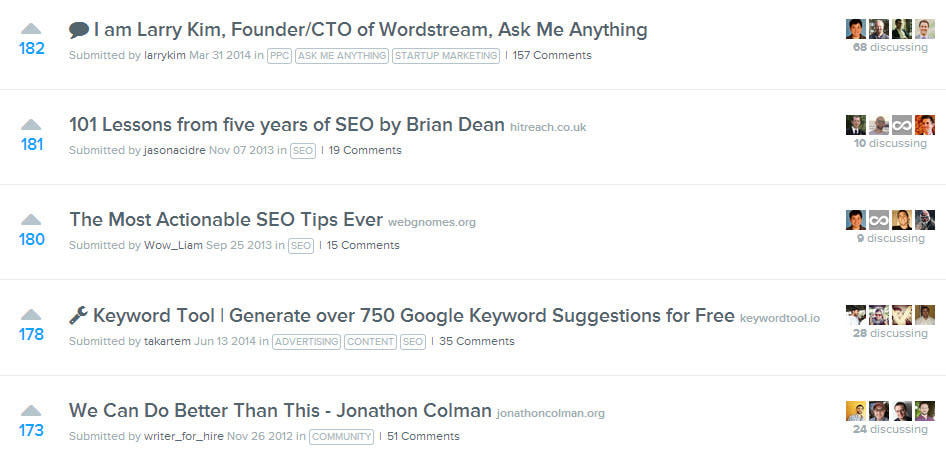
48. Submit Your Content to Aggregator Sites
Firstly, a disclaimer – don’t spam Reddit and other similar sites hoping to “hit the jackpot” of referral traffic, because it’s not going to happen.
Members of communities like Reddit are extraordinarily savvy to spam disguised as legitimate links,
but every now and again, it doesn’t hurt to submit links that these audiences will find genuinely useful.
Choose a relevant subreddit, submit your content, then watch the traffic pour in.
49. Incorporate Video into Your Content Strategy
Text-based content is all well and good, but video can be a valuable asset in both attracting new visitors and making your site more engaging.
Data shows that information retention is significantly higher for visual material than it is for text, meaning that video
marketing is an excellent way to grab and hold your audience’s attention, and boost traffic to your website at the same time.
50. Research the Competition
If you haven’t used software like BuzzSumo to check out what your competitors are up to, you’re at a huge disadvantage.
These services aggregate the social performance of specific sites and content to provide you with an at-a-glance view of what topics are resonating with readers and,
most importantly, making the rounds on social media.
Find out what people are reading (and talking about), and emulate that kind of content to bring traffic to your website.

51. Host Webinars
People love to learn, and webinars are an excellent way to impart your wisdom to your eagerly waiting audience. Combined with an effective social promotion campaign, webinars are a great way to increase traffic to your website.
Send out an email a weak or so ahead of time, as well as a “last chance to register” reminder the day before the webinar. Make sure to archive the presentation for later viewing, and promote your webinars widely through social media.
52. Attend Conferences
Whatever industry you’re in, chances are there are at least one or two major conventions and conferences that are relevant to your business.
Attending these events is a good idea – speaking at them is even better.
Even a halfway decent speaking engagement is an excellent way to establish yourself as a thought leader in your industry and gain significant exposure for your site.
Well, that just about does it for today’s post. If you’ve got your own tips for increasing traffic to your website, I’d love to hear them.


0 Comments